catechesis by camera
in the wilds of public bioethics

Years ago, at a fancy formal reading in a wood-paneled room, I heard the poet Matthew Zapruder say, about some subject being discussed: “Well—on this I have mixed feelings — which is to say, feelings —” and there was a titter of laughter in the crowd. I think about it whenever “mixed” is said before “feelings” in conversation. Like, oh, you mean life hands you some experience and you don’t have a single-channel autonomic response? Welcome to the human race! To experience feelings at all is to carry a patchwork of contradiction. It’s our ordinary state, not in need of the qualifier.

Many of you will have heard about the recent and very public pregnancy, genetic test results, and abortion of a fetus with Down syndrome undertaken by a YouTube influencer and his wife. Jesse Ridgway shared his wife’s first pregnancy and their trajectory through routine screening tests for disabling conditions. They got a 95% likelihood prediction for Down syndrome, and at ~20 weeks gestation, his wife had an abortion. And then Ridgway told everyone about it.
I find very little satisfaction in the commentary that follows an incident like this, but the prose arising in my head is persistent. So herewith a catalog of responses and feelings, mixed:
An odd refreshment in the transparency and candor. The majority of babies with Down syndrome in utero are aborted — upwards of 68% in the United States and much closer to 100% elsewhere, including in the resource-rich welfare states of the world (Iceland, Denmark, others). Part of me welcomes the honesty of this couple. Their statements reflect the revealed preferences of most people in their actions, and some days I prefer this baldly straightforward calculus and speech to the impassioned, righteous rhetoric I see in online comments.
Every semester, in my disability and design class, I teach the basics of selective abortion to undergraduates. Hearing this issue laid out for the first time and conditioned by the politesse of the modern university, nearly all of them express an instinctual moral offense, or at least a deep ambivalence. But once in a while a student will venture forth a more unguarded account: Well, if there’s very little you can control about a child’s future difficulties, but you could control this one aspect ahead of time, why wouldn’t you? Or: look, some people just want to plan for a child who will eventually leave the house. They are saying what most people are thinking as they choose their choices, and I thank those students every time for speaking up. If having a baby is a lifestyle option, a project to earnestly manage, then why not utilize this (painful) culling process? It makes rational sense under a family-making project rubric.
If you don’t accept the optimized project rubric for having children, then you should think all the way through what an alternative rubric might be, and how it might shift the very foundations undergirding family-making, period. But most people short-circuit well before what Kierkegaard called “thinking a thought whole” — taking seriously a line of reasoning all the way through to its implications.1 For most people opining on selective abortion, including many of my counterparts in disability advocacy, it feels better to say publicly: You’re missing the heart of the matter, your judgments are misguided, I would never do what you did. And afterward, in any sustained conversation, most people will shrug and concede that each couple makes “the decision that is right for them.” We manage our collective uncertainty by redounding to the sole good of private choice: the project rubric. But it feels much better to see ourselves occupying the rightly-calibrated rhetorical high ground. On some days, I welcome couples like this just speaking very plainly.
What I can only describe as media horror. This must be partly a generation gap thing, but I was unprepared for the excruciating revulsion I felt in watching this couple receive, read aloud, and respond to the test results ordered by their doctor. I felt revulsion on their behalf, though — for their commitment to a distorted idea of authenticity and their golden-handcuffs commitment to making a living via clicks, all of which seemed to require an exhibitionism in extremis. Call it, maybe, catechized by the camera? They are stunned by the blowback, they’ve said. It seems like the scrim of digitally mediated life creates the conditions for this all-performance-all-the-time, but also for their surprise at the criticism. By now we know the pitfalls of online simulacra that’s nudging our real-time choices. It’s just that these macabre incidents lay it all bare: A life taped, edited, and shared by the influencer class bundles together the strong narrative structures that make a good story — what happened and what happened next, reversals of fortune — with the governing idolatry of self-display, in a tight feedback loop with a bloated, amorphous public that influencers call their “community,” something resembling friends and neighbors.
The intellectual anemia of our thin public bioethics. One of the most memorable lightbulb-switch books I’ve read in recent years is sociologist John Evans’s Playing God? Human Genetic Engineering and the Rationalization of Public Bioethical Debate. Evans traces a history of bioethics in the United States over the 20th century, showing how its professionalization in the 1960s-70s took first-order philosophical questions on health and medicine out of the public sphere and sequestered them into narrow forms of debate about technological means, bypassing substantive deliberation about ends.
Where once scientists and theologians routinely offered lively, existentially weighty frameworks for the public to understand the promises and perils of medical technologies, the formalization of bioethics reduced debate to much more procedural, safeguarding judgments. Contemporary bioethical practice seeks a prudential treatment of how questions, but it often leaves aside most questions about why. Evans says this change can be described as a “thinning” of the entire structure of bioethical discourse. For the matters in our lives that demand the most informed analytical precision and vivid philosophical imagination — demanding, that is, a thick rationality — we have the flimsiest, floppiest of discursive planes.
The Ridgways, in other words, have been abandoned to a paper-thin amalgam of their empiricism2 and their tacit project rubric for navigating the conveyor belt of choices that come with routine maternity care. What they needed was a big-wisdom metaphysical and cultural and clinical conversation as accompaniment, and what they got instead was what’s available: biomarkers and percentages and abstractions, and a spreadsheet calculus for the life of a human being. No wonder the comment sections in their wake feel so empty and unsatisfying.
And then, this:
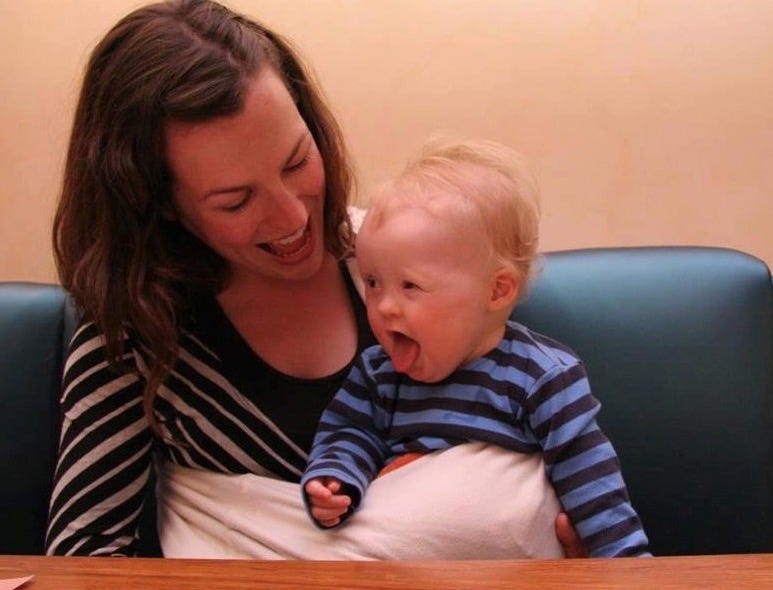
Twenty years into sharing life with my own first of three babies, one with Down syndrome, I have, yes, a visceral wailing grief at the loss of a human person — one eagerly imagined as a person and then, overnight, un-personed by genetic information. Because it was their first baby, this couple was especially alone, especially ignorant about what they were assenting to or declining. The experiential divide between knowing a baby not yet born — even one kicking and present in your own body — and the one you hold in your arms and care for — it’s a gulf that begs for monumental metaphors. There’s an oceanic distance between the abstraction and its embodiment. Making room for a child isn’t fully thinkable-through with just your skull-shaped cognition. It’s in the habitus of your body. Becoming a parent is like swallowing a solar system: a reordered gravitational pull, a new series of orbits, with magnetism and polarities that sway all of life’s conditions. It is many things, but it is not a project.
Less talk, more come-and-see. Most of my energy goes to reporting on the best arguments-by-design for living outside of optimized projects. In the spring issue of Comment, I have a long piece on what I’d like to see more of in the world: affirmative forms of life that are designed and built and assembled and networked for people in embodied space-time. An architecture studio devoted to modest rural buildings; a village for dementia care; urban hydroponic agriculture. And some wandering meditation on design education, virtue ethics, and Christopher Alexander’s A Pattern Language. You might like it.
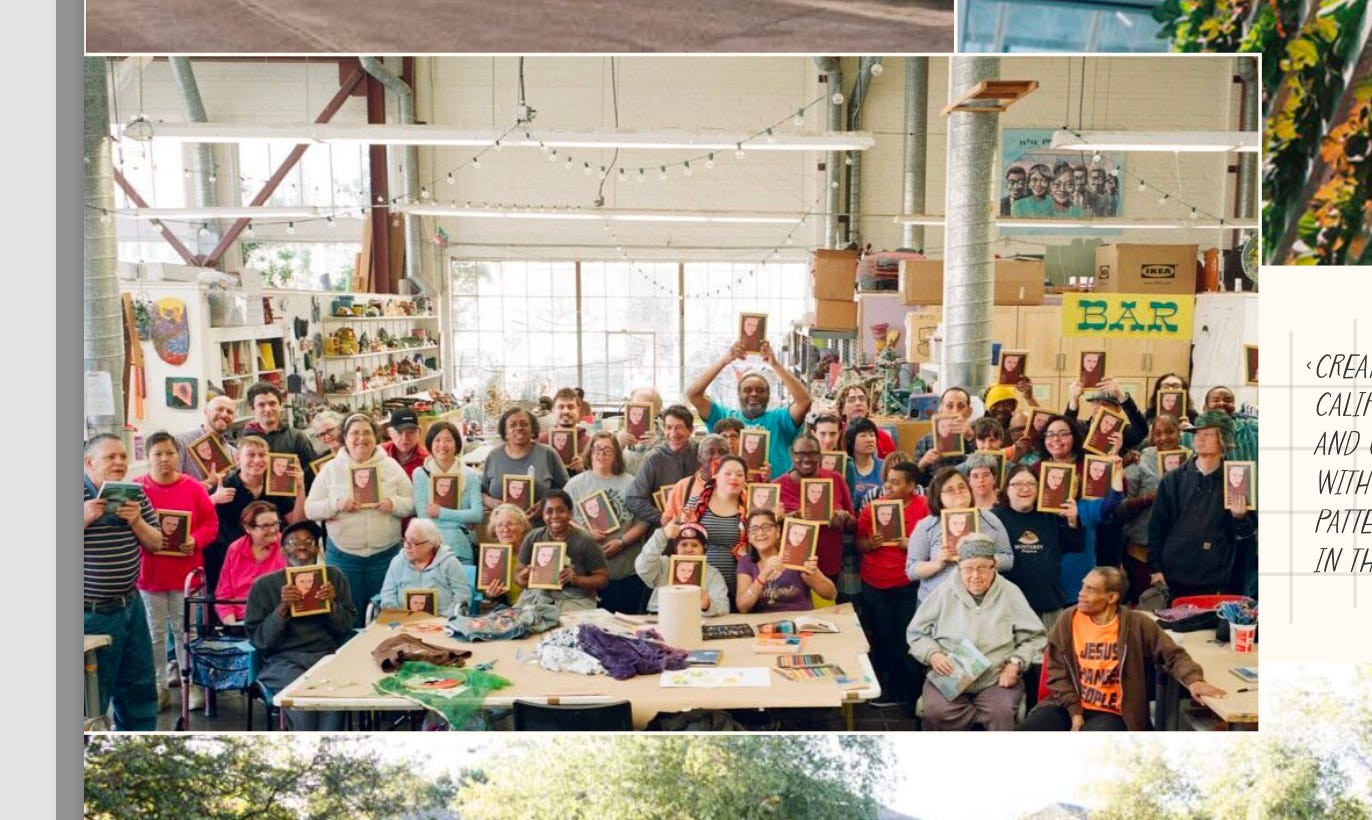
Honestly, though—enough chatter! Enough chatter from ponderous academics like me. I write this to remind myself most of all: I’d rather help nurture an irresistibly beautiful and human-constrained future.
Glad you’re here. At some point you signed up for this newsletter; the unsubscribe button is below. Or maybe share it? I’ve finally hired an editor to help me get some of the several dozen drafted pieces out and into the world, so you can expect to see more here. In 2026 it seems necessary to say: No part of this newsletter, or anything else I write to you, is written with AI. Orson Welles said the enemy of art is the absence of limitations. You will always find me struggling productively against my own.
To be clear, I do this all the time and did so about the selective abortion issue for much of my adulthood. Someday I’ll write an essay that makes more sense of how, many years after my son was born, I suddenly had to rethink so much.
Even his empirical data lacks nuance, however. Read about, for example, heart defects here (near 100% survival rates for mild to moderate defects, in part due to fantastic surgery repairs and in part due to natural repairs/spontaneous closure). I don’t mean to suggest there aren’t some serious medical issues that can attend Trisomy 21, just that Jesse Ridgway’s “objectively shitty” claim is…reductive.
loved this. esp the part about not loving what you can't see. i wrote about that a bit here; some of the stark-ness was lost in edits, but so much of the musing about how many children, whether children, whether contraception operates as if these decisions can be made in the abstract. there are only particular people to love, to grieve, to lose, to parcel out energy for. its all irreducibly particular. https://www.plough.com/articles/in-the-shoes-of-the-woman-considering-abortion
I wrote a piece on the idea of children as a project, and how that falls apart in the lives of very poor women, but they still have children. Not sure there is any space in influencer culture for relationship that isn't "forward moving project" so I'm not surprised that particular incident of selective abortion created a kind of collision. Like you, the long journey of accompanying children who most of the world think should have been aborted has made my thoughts on life issues, unplanned trajectories and accepting the given as gift much more nuanced Are Children a Good Idea? - Comment Magazine https://share.google/4ElAodoyZO7nwttv5